A figure of stories.
Folk identifications, parish memory, and the long custom of re-making him in our own image.
A history of being looked at.
Mythology, here, doesn’t mean myth in the loose modern sense of “thing that isn’t true”. It means the body of stories, identifications, and folk practices that have grown up around the figure — the way each generation has folded him into its own imagination, and what those foldings tell us about the figure (and about us).
The Long Man has been, at different times: a Saxon warlord, a Roman standard-bearer, a prehistoric shaman, a medieval pilgrim, a doorway, a measuring stick for the fields below, and a giant fond of the moon. Some of these are wrong but useful. Some are useful and probably also right.
The local giant.
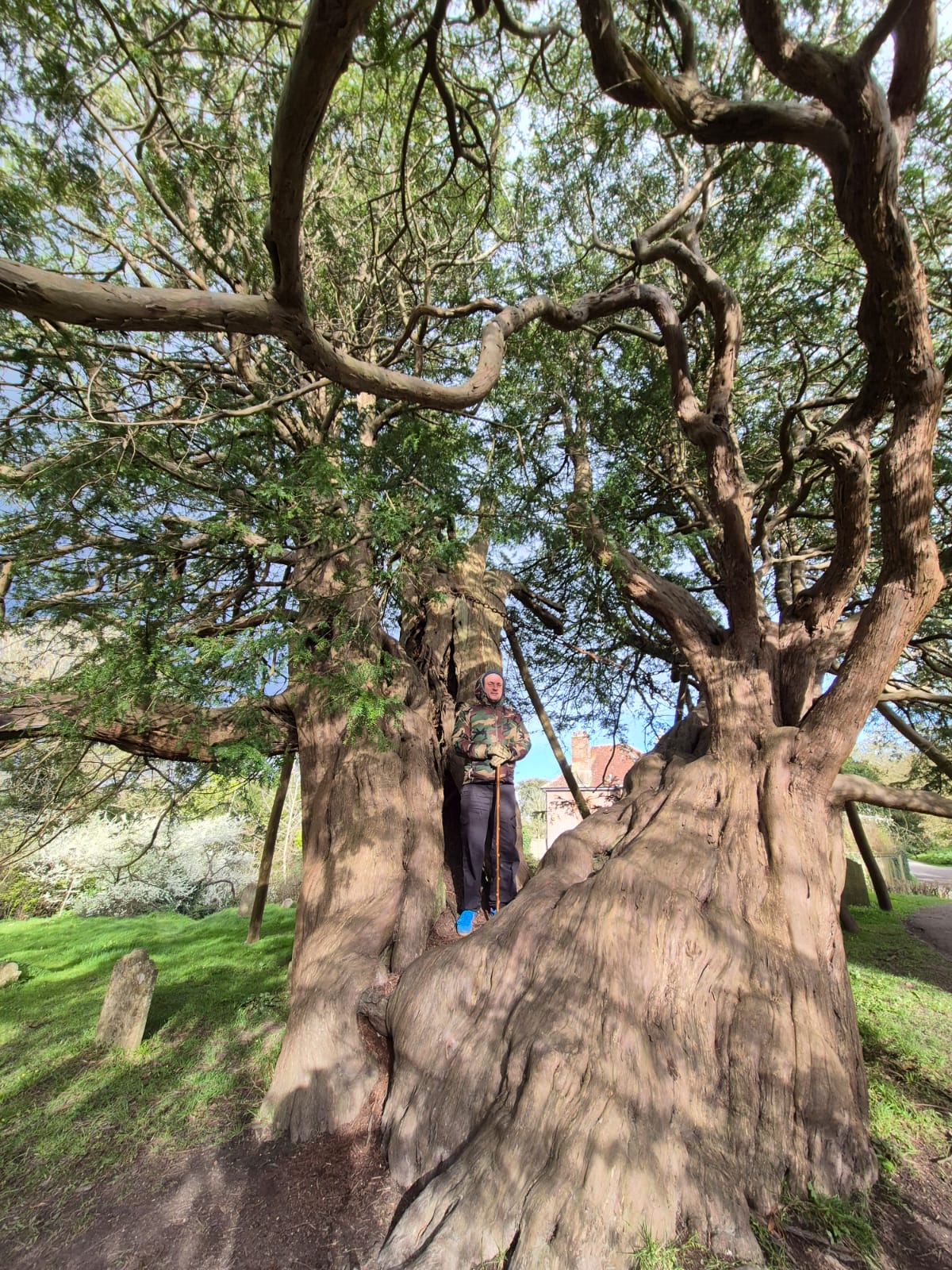
The oldest layer of folk identification — the one that survived in parish memory into the early twentieth century — is also the simplest. The Long Man is a giant. Local stories of the eighteenth and nineteenth centuries refer to him interchangeably as “The Lone Man”, “The Wilmington Giant”, and (in Sussex dialect transcriptions) “th’owd man on Windover”.
The story is straightforward: he is a giant who lived on the hill, fought another giant on Firle Beacon to the west, was killed (variously by being tricked, by being struck by lightning, or by hitting his head on the slope), and is now buried at the foot of his own outline. The mound at the eastern foot of Windover, since shown by archaeology to be a long barrow of much earlier date, is identified in folk speech as the giant’s grave.
He is a giant who lived on the hill, fought another giant on Firle, and is now buried at the foot of his own outline.
Two staves, one door.
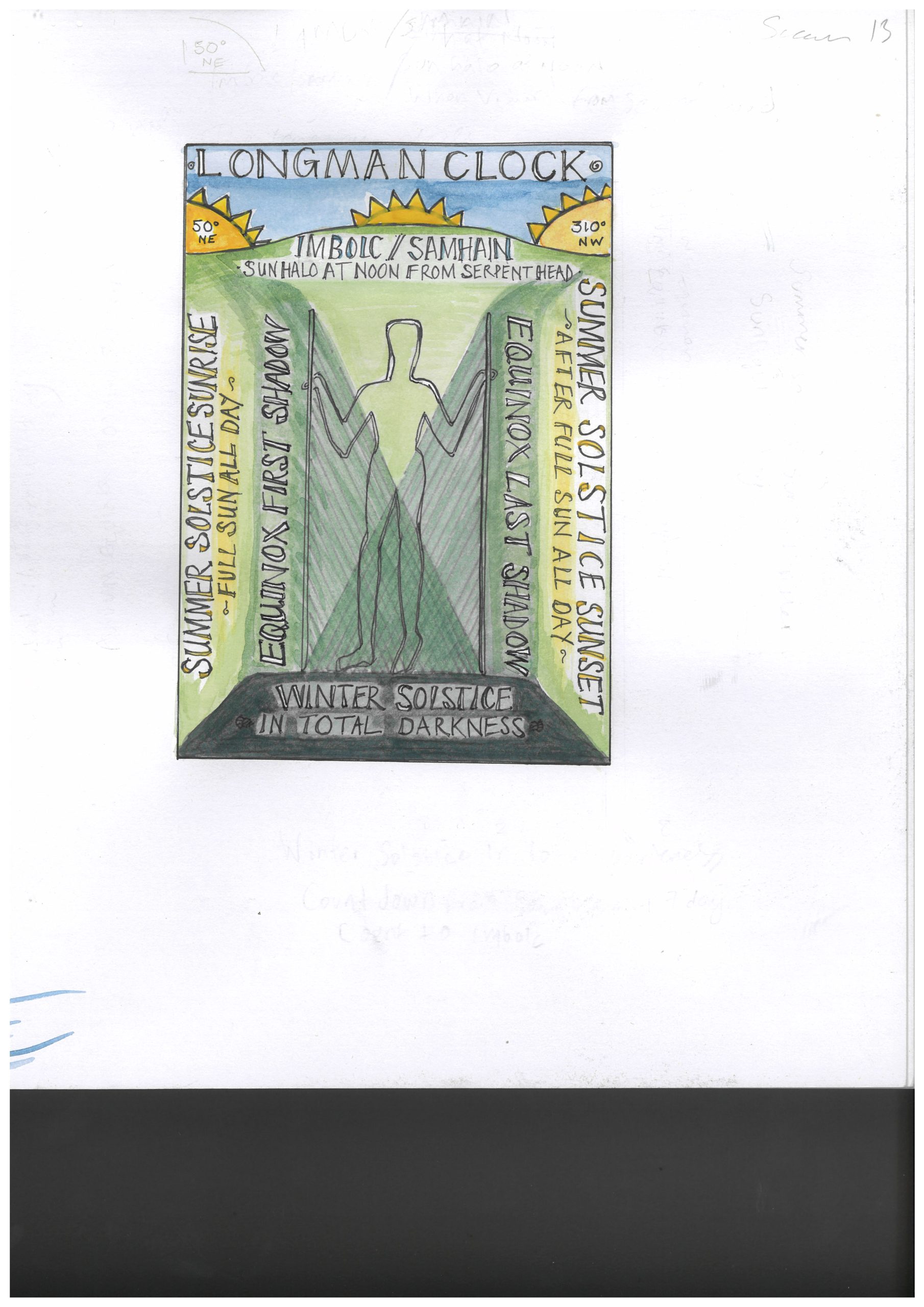
The figure’s most distinctive attribute — the two upright staves — has accumulated more interpretation than any other element. To Watkins they were ley-line markers. To early archaeologists they were the spears of a Saxon warrior. To the twentieth-century neo-pagan revival they became wands or initiation rods.
The reading I find most generous to the evidence is older and quieter. In the medieval and early-modern parish, two upright posts beside a figure were the conventional sign of a doorway: a threshold, a gate, a place of passage. This is the sign you find on inn signboards and on parish boundary marks. A figure between two posts is not, in that visual grammar, a warrior. He is a doorkeeper.
What he is the door to is, of course, the question. The literal answer — that he stands between two routes through the South Downs — is the most boring and probably the most correct. The richer answers, and the ones the book devotes most space to, sit at the join of mythology and archaeoastronomy.
The pilgrim and the road.
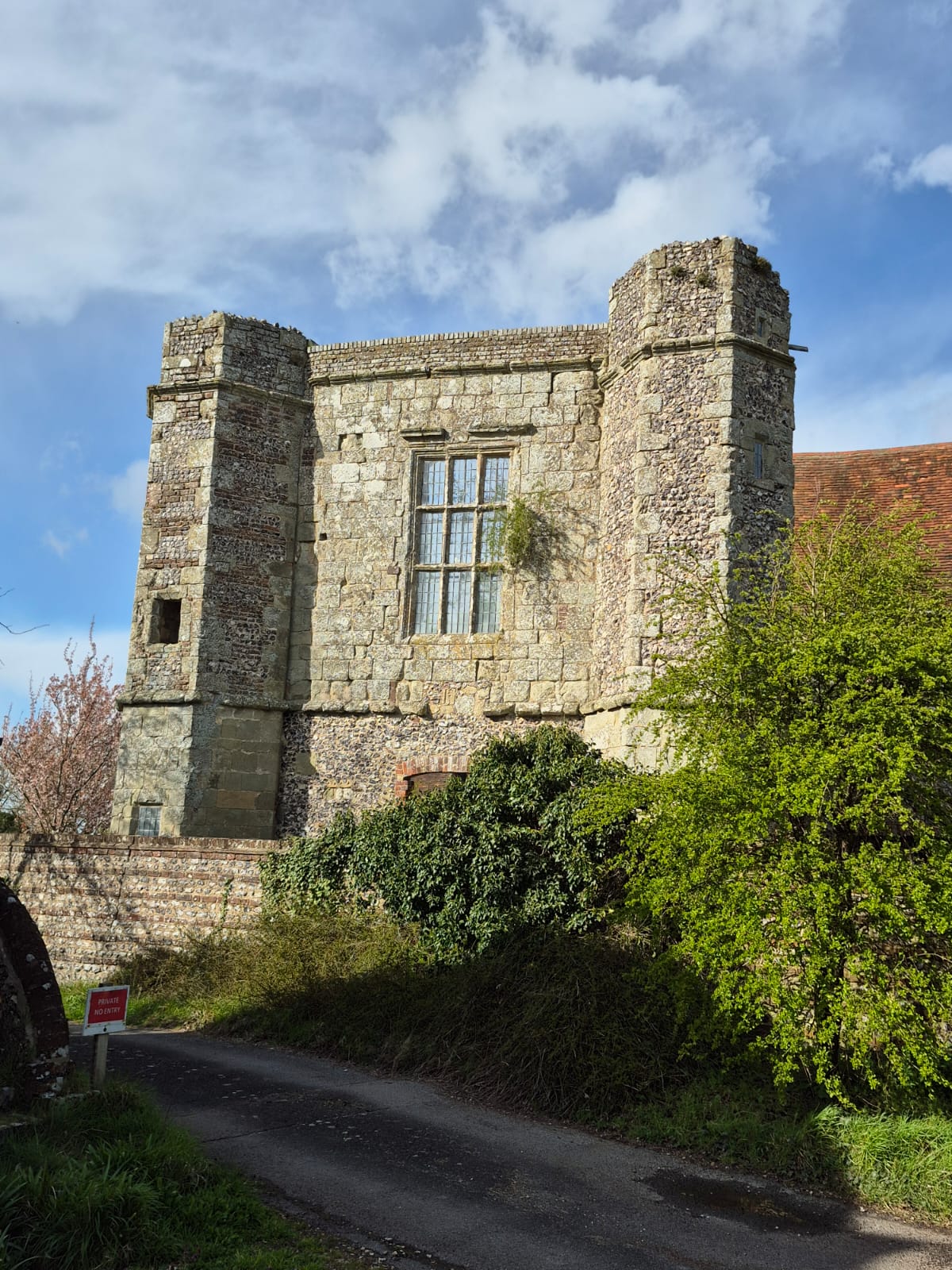
By the high medieval period, the figure had been folded into Christian topography. Wilmington Priory was founded next door, the village pilgrim route ran along the foot of his hill, and contemporary devotional drawings sometimes identify him as St Christopher — the patron of travellers, conventionally shown as a giant carrying a staff.
This is almost certainly a re-fitting, not a discovery. Christian Europe was practised at the assimilation of pre-Christian figures, and the Long Man would have been an obvious candidate — tall, hill-side, ancient-looking, already a known landmark for travellers. The St Christopher reading would have been useful to the priory and harmless to the figure himself.
What matters is that the assimilation didn’t entirely take. Folk identification of the figure as a pre-Christian giant survived alongside the Christianised reading and outlasted it. The priory ruins are now ruins; the giant is still on the hill.
A figure with three faces.
The mythology layer leaves us with a figure who has been read at least three different ways within recorded memory: a giant with a grave at his foot, a doorkeeper between two posts, and a Christianised pilgrim with a staff. Each reading was useful to the people doing the reading. Each reading is partial.
What the three readings share is a surprising amount of structural detail: a tall figure on a hill, holding two upright objects, marking a place of transition. The transitions differ — between worlds, between routes, between religious ages — but the figure is consistently a sign that you are at a threshold.
That structural reading carries straight into the third thread.
Continue with Archaeoastronomy.
Thread III — sun, moon, and the long mathematics of the hill.