The Long Man.
Two hundred and thirty-five feet of chalk-cut man, north-facing, on the steepest slope of Windover Hill.
A figure of measurable things.
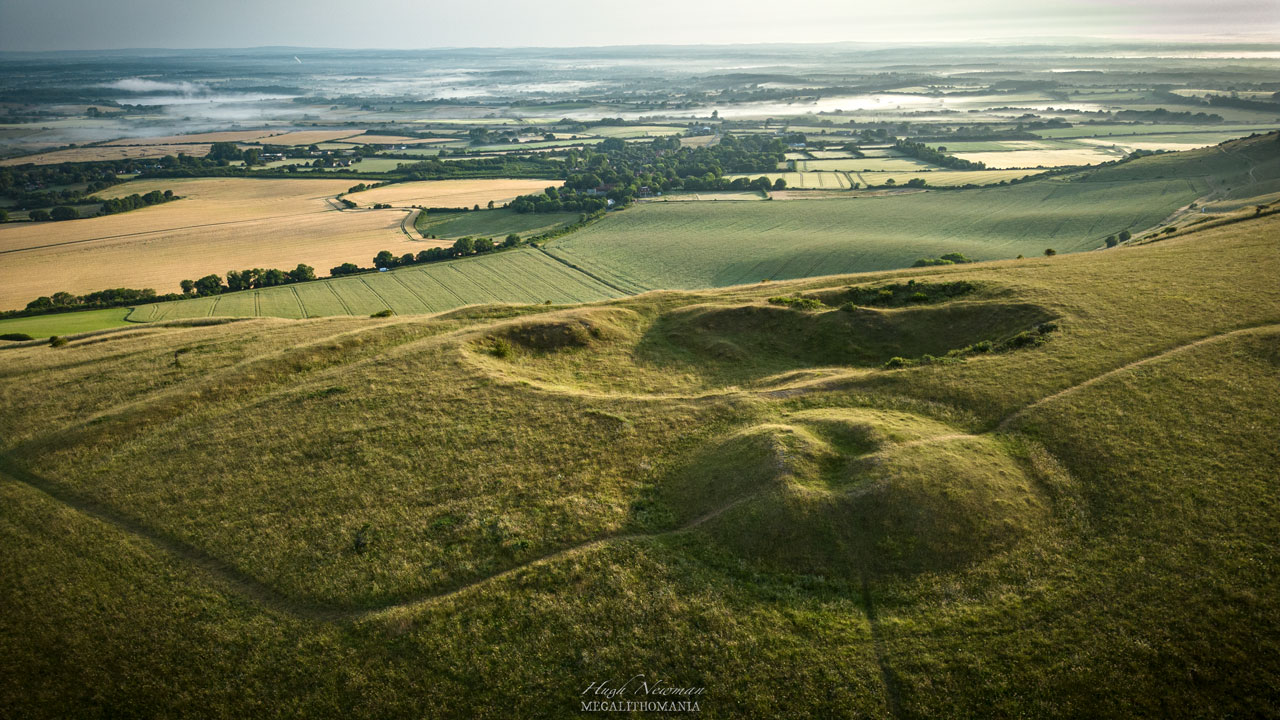
On Windover Hill.
The figure occupies the northern face of Windover Hill, between the villages of Wilmington and Folkington in East Sussex. The ground falls away steeply from the summit at roughly thirty degrees, and his outline runs almost vertically up that fall.
Because the slope is so steep, the figure is distorted when seen from above — he reads as squat and broad. From the path that runs along the foot of the hill he resolves into proper proportions: a tall, slim, balanced human form, both arms extended, holding a staff in each hand.
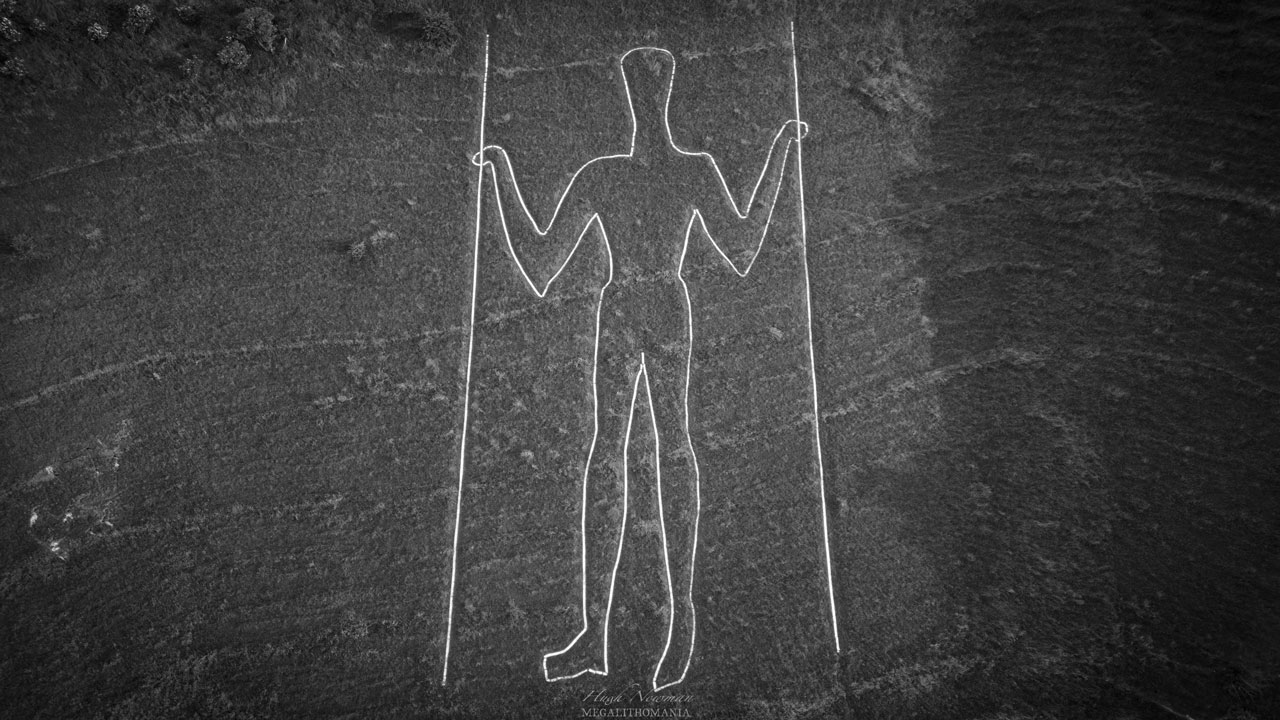
Outline, not cut.
Unlike his cousin the Cerne Abbas Giant, the Long Man is not a chalk fill. He is an outline — a line cut into the turf, with the body left as grass. The line is now picked out in white concrete blocks set flush with the slope, replacing the older method of yearly re-chalking that had grown impractical.
He was almost certainly originally a turf-cut outline: medieval and early-modern accounts describe a faint line, only properly visible at certain times of day or when raked clean. The high-contrast figure visible from the road today is a twentieth-century intervention, intended to keep him legible from a distance.
He stands alone among the hill figures of Britain — outlined, not filled; staffed, not weaponed; faceless, not portrayed.
A figure with no firm date.
The honest answer is that we do not know. The earliest unambiguous record is a sketch by John Rowley, surveyor of Wilmington Priory, in 1710 — but his drawing assumes the figure already existed, and the antiquarians who came after him took its antiquity for granted. There is no datable layer at the figure itself, because the cutting was renewed and the chalk re-dressed many times.
Modern excavation under the line has produced fragments that argue for an early date and fragments that argue for a much later one. The current scholarly consensus, such as it is, sits somewhere between late prehistoric and early post-medieval, with most working archaeologists comfortable with the figure as we see him being a re-cut of something significantly older.
The fuller story — and there is a fuller story — is in the History chapter.
Read the three approaches.
History · Mythology · Archaeoastronomy