A figure in the sky.
The hill, the horizon, and the long mathematics of solstice, equinox and standstill.
A working hypothesis.
Archaeoastronomy is the most contested of the three threads, and for good reason: the discipline has produced both careful work and outright nonsense in equal measure, and the difference is not always obvious from the outside. The standard for serious work is high, and most published claims about the Long Man’s astronomical alignments do not meet it.
The position taken in this chapter (and at greater length in the book) is that the figure’s placement on Windover Hill encodes at least one and probably two deliberate astronomical sightlines, that these were almost certainly known to whoever first laid out the original outline, and that they survive into the modern figure because the position of the outline on the slope has been broadly preserved across re-cuttings.
That is a careful claim. It is not the same as saying he is “a solar calendar” or “aligned to Stonehenge”, which he isn’t.
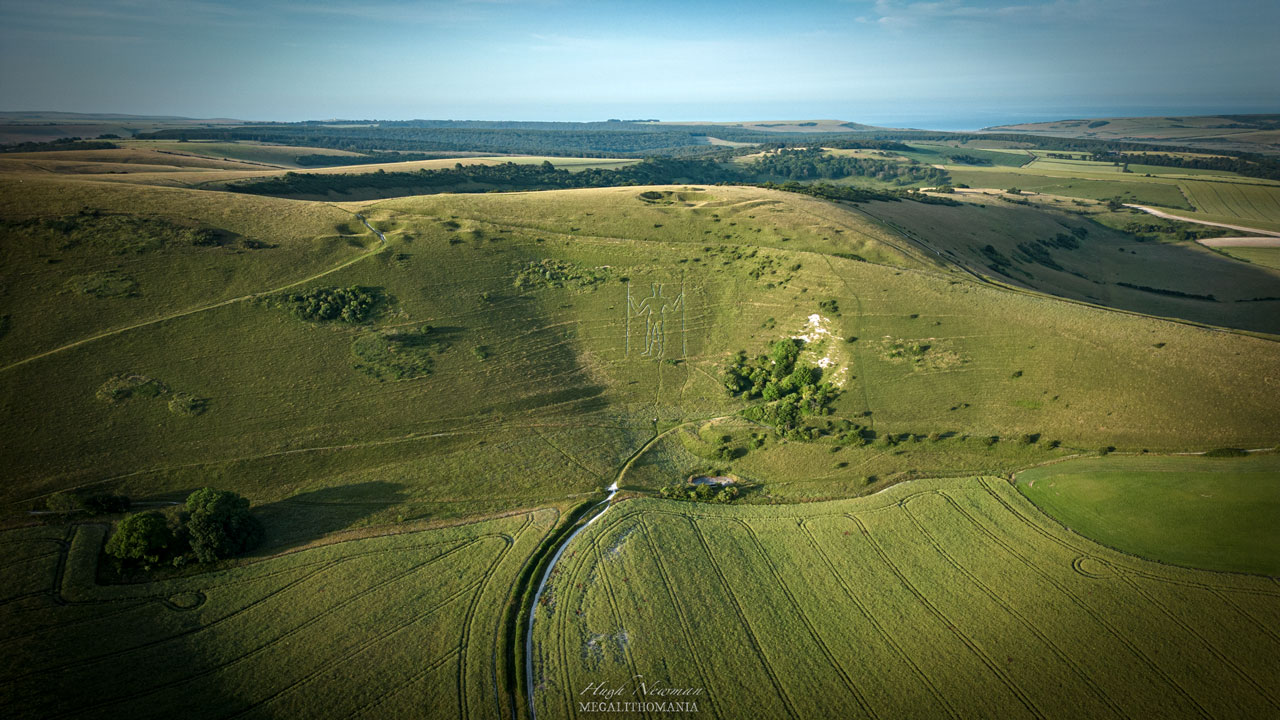
The summer solstice sightline.
From the foot of the figure, looking along his right-hand staff towards the eastern horizon, the line of sight rises to clear the shoulder of Windover at an angle of approximately 51° east of true north. On the morning of the summer solstice, the sun rises at 50.7° east of true north as observed from this latitude.
The match is within the resolution of careful eye observation, and it is preserved across the antiquarian re-cuttings because the staff, though redrawn, has been redrawn in approximately the same position. This is the strongest of the figure’s astronomical alignments and the only one I would defend as deliberate without further qualification.
The match is within the resolution of careful eye observation. This is the strongest of the figure's alignments.
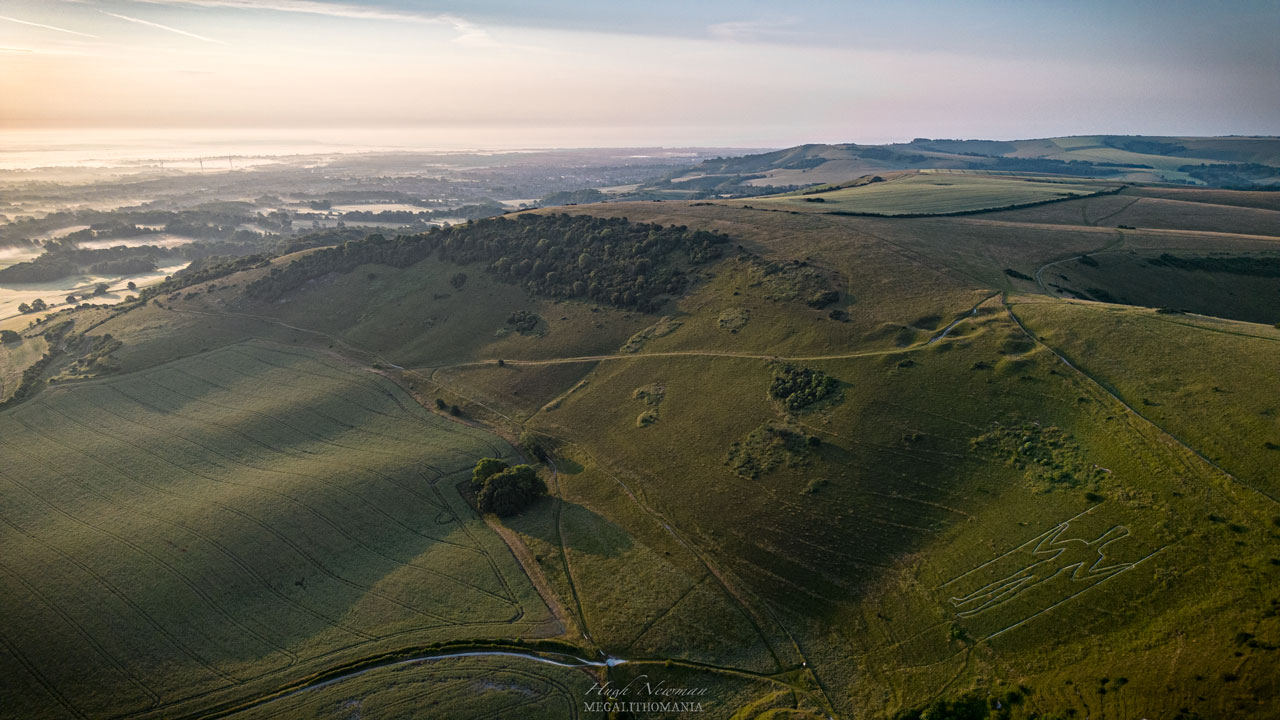
Equinox shadow, Imbolc light.
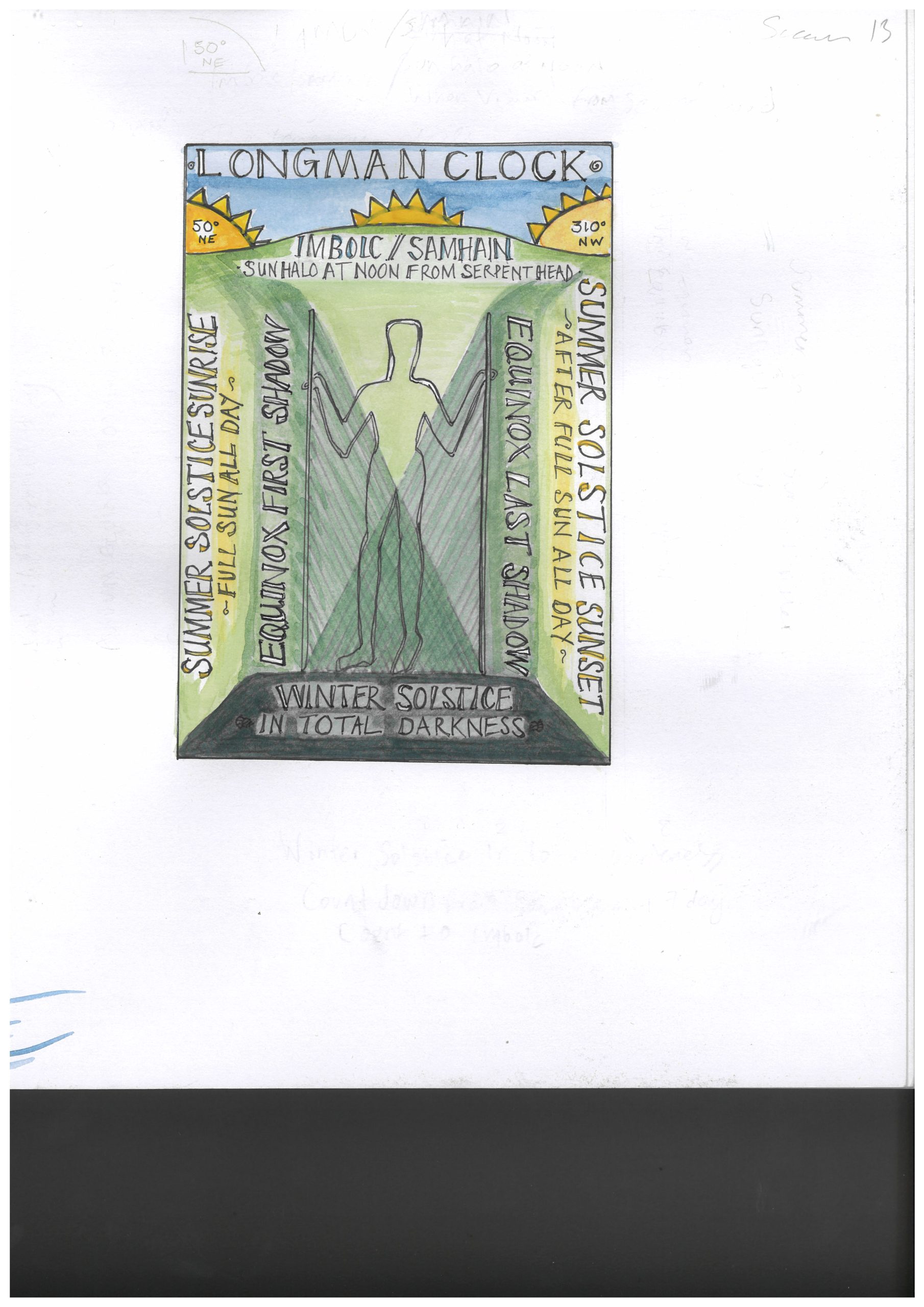
The hill itself is part of the figure. At the equinoxes — the two days of the year when day and night are of equal length — the shadow cast by the rising sun on Windover’s eastern flank reaches its noon position at the foot of the figure. The figure stands in his own shadow for a measurable period, and emerges from it as the morning advances. This is observable today and is not artefactual.
At Imbolc, the cross-quarter day in early February that marks the beginning of spring in the older calendar, the rising sun comes up over a notch in the eastern hills and casts a brief, narrow beam of light along the line of the figure’s left arm. The beam lasts about four minutes. Modern observers have caught it on camera in 2003, 2014, 2019, 2023, and (most clearly) at the equinox-Imbolc cross of 2026.
Whether these effects were intended by the figure’s original makers is more difficult to argue. They may be incidental consequences of the slope and the orientation, rather than encoded sightlines. The book takes the position that they were almost certainly noticed if not intended — that any community looking at this figure for any length of time would have come to know these light-behaviours and built ritual around them — but does not push the harder claim of original intentionality.
The lunar standstills.
The moon’s rising and setting points on the horizon vary on an 18.6-year cycle: the major and minor lunar standstills. At the major standstill the moon rises and sets at its most extreme positions; at the minor, at its least. The cycle is long enough that any culture interested in observing it would need a sustained, multi-generational observational practice.
From the foot of the Long Man, the major standstill moonrise of 2006 occurred at almost exactly the position of the summer solstice sunrise — close enough that, at this latitude and from this slope, the two events would have been difficult to distinguish without careful instrumentation. The major standstill of 2025 was equally striking, and the next one, in 2043, will be a useful test of the alignment.
The lunar standstill thread is the most speculative of the three. The figure’s position is consistent with deliberate lunar observation, but consistent is not the same as proves. The book argues this thread cautiously and presents the alternatives.
The cycle is long enough that any culture interested in observing it would need a sustained, multi-generational observational practice.
The argument.
One firm alignment (the summer solstice sunrise), two suggestive light-behaviours (equinox shadow, Imbolc beam), and one speculative long-cycle alignment (lunar standstill). That is not nothing, and it is not Stonehenge.
Taken together with the History thread (a figure that probably pre-existed the documentary record) and the Mythology thread (a figure consistently read as a doorkeeper between worlds), the archaeoastronomical evidence suggests that the Long Man was at least partly an instrument: a way of reading the year against the hill, a way of marking the threshold between dark and light parts of the calendar.
That is the argument the book takes 320 pages to make, with all the maps, all the photographs, and all the qualifications it deserves.
Read the full argument.
All three threads, in one volume.